
Looking Out for One Another – Parshat Mishpatim
Dear fellow members of Harvard’s Jewish community,
I hope my message finds you, and those you love, well.
Thirty years ago the great Harvard sociologist (and adult convert to Judaism) Robert Putnam published his ground-breaking article sounding the alarm of declining community and social bonds in America, “Bowling Alone” (five years later he would publish the book of the same title.) It is hard to remember that Americans’ lives were well on their way to today’s epidemic of loneliness before the internet, iPhones, and social media together accelerated our collective descent into isolation. And there is nothing more central to Judaism than community – the bonds of sociality, friendship, trust, and conflict: the most prominent Jewish theological tradition is that G!?d’s covenantal promises are not with each and every one of us individually, but rather with the collectivity of the Jewish people.
How do we build a community that is not merely tolerant (though in a polarized society, that is no mean feat), but supportive and kind – a place where we know that others have our backs? The Torah, as it so often does, begins with something specific and of surprising power: the mitzvah of returning a lost object (Exodus 23:4, in this week’s parasha, Mishpatim). For those of you inclined to legal precision: in Jewish jurisprudence, a person who finds acquires it, and if they fail to return it they have not violated the prohibition against stealing – they have failed to fulfill a positive commandment to seek out the object’s owner and reunite her with her erstwhile possession.
I imagine each of us has experienced the relief and gratitude of someone walking up to us, carrying something we’d lost and given up looking for – a joy that exceeds the significance of the object itself, and includes the satisfaction of knowing that those around us keep us in mind, and care about and for us. The Torah instructs us to be just this kind of person – one who looks out for others, going beyond the base-line requirement of doing no harm in favor of active and pro-active concern for them and their welfare.
A particularly poignant retelling of the Jews’ march through the desert from Sinai to Israel concretizes this vision. The Torah assigns each of the twelve tribes a specific slot as the group traveled between each of the desert’s 42 encampments, with the tribe of Judah in front and the tribe of Dan in the rear. As our Rabbis imagine (or remember) it, the tribe of Dan lagged behind the throng of migrating Jews, collecting as they went anything that their fellow travelers had dropped or left behind. One pictures everything from tired donkeys who’d broken away to teddy bears that slipped from children’s tiny hands. Dan’s job was to collect each of these and then, upon reaching the next destination, open a national lost-and-found – reuniting owners and objects, and forging the bonds of trust that transformed a group of former slaves into a caring collective.
When it comes to looking out for one another, the Torah is not only nostalgic, it is also realistic. In Deuteronomy, the restatement of the laws of lost objects occurs in a more economically integrated and developed context: we encounter the problem of an object found at a crossroads, rendering it unclear not only who the original owner was, but whether they will ever return to reclaim what was theirs. (How long must one feed a chicken one has found before selling it? Who pays for the feed, and who is the owner of the eggs?) And in the Mishna, centuries later, our Rabbis confront the realities of mass-produced, indistinguishable items – which for the first time in the history of material culture render it impossible at times to adjudicate between two claimants to an object, since neither can produce any distinguishing marks to validate their claim.
The acceleration of change in our times has outstripped what our ancestors could have imagined, as people traverse the globe in hours, and ideas spread worldwide in nanoseconds. All of this, as Putnam saw and foresaw, has made the work of building a community of trust and care more difficult than ever – but also more vital. It is precisely Judaism’s knack for understanding and building community that makes Jewish life, at Harvard and elsewhere, a source of hope and meaning for today’s students and tomorrow’s world.
This type of community is best exemplified by a student who walked into my office five years ago: he had come across razor blades in his roommates’ backpack, and was concerned that his roommate was harming himself. I think about those students often here: what it means to live in a community where we are not merely accepted, and not only known, but seen and cared for – even when it is scary to confront another’s vulnerability, and difficult to know how to help them. That is what this Jewish community can, and ought to, be: students should know that others are looking out for them, and that it is their noble responsibility to look out for others – and that, when they find themselves in a situation for which they are unprepared, there will be caring, wise, and discreet grownups to support and guide them.
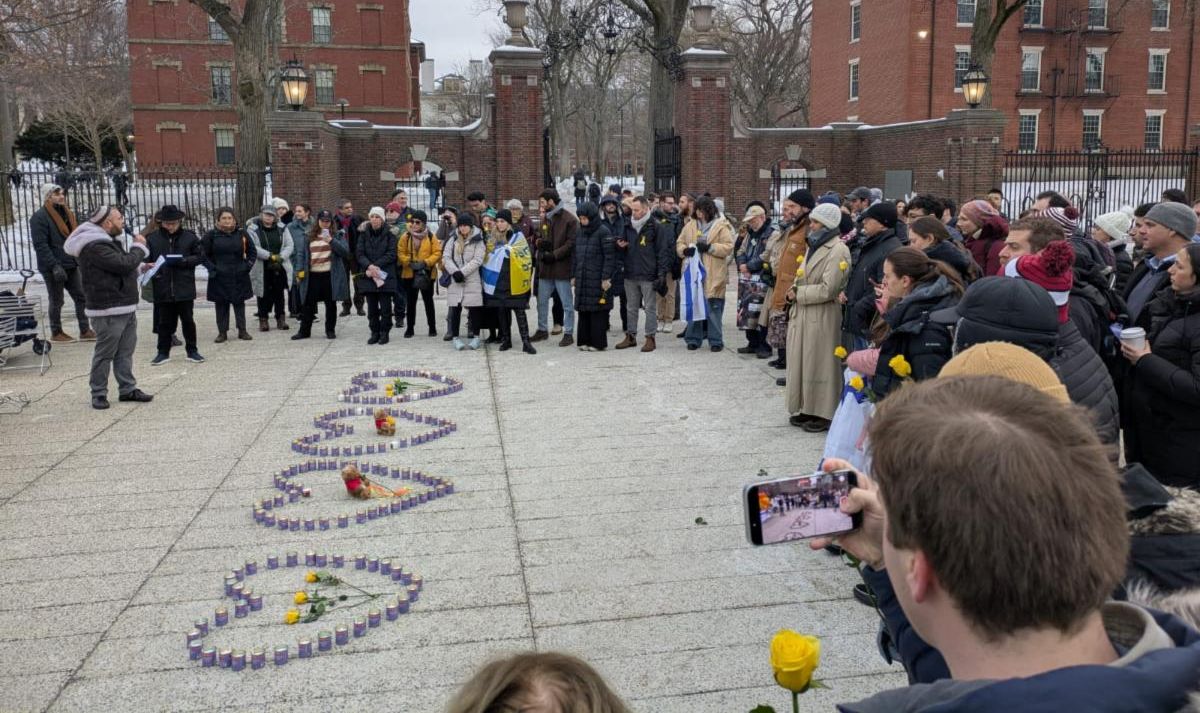
Two hours ago, those of us on campus made real our commitment to looking out for and caring about one another – when over a hundred of us gathered in front of the Science Center in a memorial vigil for the Bibas and Lifschitz families.
I want to thank all of our community members, for it is through your care for and dedication to Jewish students at Harvard today, living exactly the values we hope to instill in them, that they can assume their place in an unbroken chain, from our ancestors wandering in the desert, forward to eternity, of living with and for one another.
Shabbat shalom,

Rabbi Jason Rubenstein
Executive Director
Harvard Hillel