Mazal Tov To The Class of 2025
I hope my message finds you, and those you love, well.
Please join me in welcoming the class of 2025 into the fellowship of Harvard’s Jewish alumni.
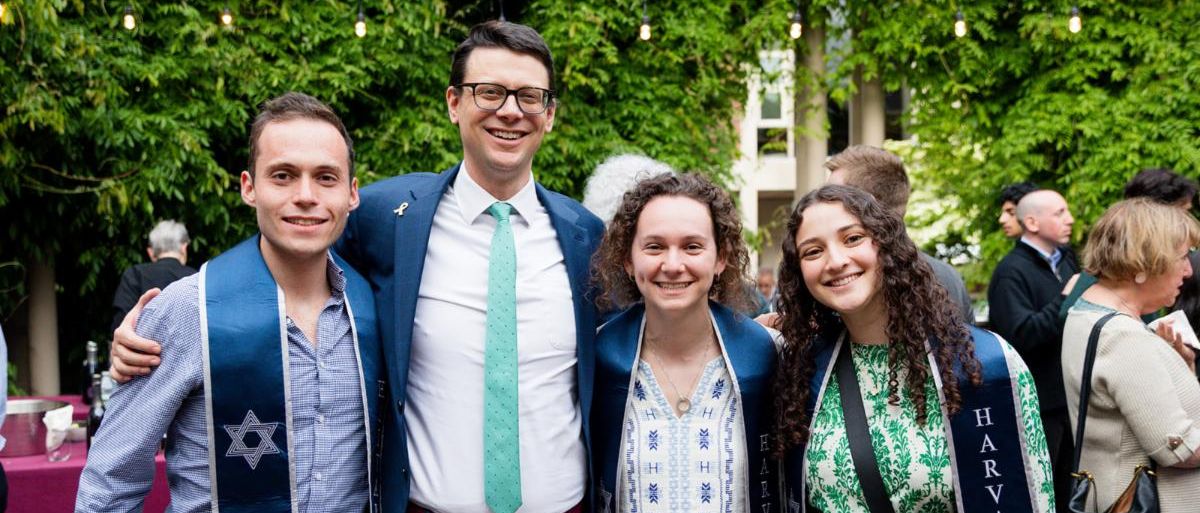
Tuesday evening, we partnered with Harvard Chabad to throw these graduates and their family the party they deserve – and I think you’ll see from these pictures that this class, who’s gone through so much from COVID to campus conflict, knows how to appreciate their hard-won blessings.
And yesterday at Commencement I was filled with pride and excitement for these remarkable young people, accompanied by a pang of sadness as well, at having personally shared only one year with them on campus. We have so much more to learn and do together – and I cannot wait for those conversations, shared meals, and connections that will blossom in the decades to come.
Below I’m sharing with you what I wrote to the Harvard community, as a column in the Commencement edition of the Crimson. In addition to the message of the words themselves – which I believe to be the reason college leaves life-long traces etched deep in our souls – I wanted to convey something else: Judaism has something universal, existential, and poignantly uplifting to offer. I could have reflected on working against anti-Semitism, or the role of Israelis and Judaism at Harvard, or our responsibility to resist the illiberal forces of the left and the right which threaten not only the Jewish community but all of us.
But instead, I aimed to meet Maimonides’s description (Virtues 2:2), “What should a person whose soul is ill at ease do? Consult with a scholar, for they are healers of souls.” We will never fail to defend ourselves, nor will we ever forget that Judaism is not exhausted by defense, but soars above. That was the aftertaste of Judaism I wanted to leave the Class of 2025, Jew and gentile alike, with on the day of their Commencement. I share these words with all of you as a reminder of not just why, but how, our connection to this community began, and how and why we will carry it with us to the ends of our days – or, as Fair Harvard (since 2017) puts it, “‘til the stars in the firmament die.”
From the pages of the Crimson:
“The day of death is better than the day of birth… and the end of a thing is better than its beginning” (Ecclesiastes 7:1; 7:8).
The ferocity of debate over ideas and politics — and your four years saw these arguments run as white-hot as any time at Harvard — often hides a deeper, and incorrect, consensus: that the most important learnings of college, and the most important commitments of a life, are in the realms of politics and ideas. What will you change in the material conditions of life; which frontier of knowledge will you surpass; and in your four years here, which causes have you championed, and what ideas and intellectual frameworks have you accomplished.
The greater part of what you all have learned is in composing a life — and you have learned it through your successes and failures alike. At its most existential and most poignant, college is a life lived in miniature — a full arc of development, flourishing, achievement and failure, pride and regret, reflection, and then, an ending. Just as children play at battles or business, shopping or building a home — in college you have played, consciously or otherwise, at the fullness of life. As you confront the end of this span of your lives, you have the blessing of reflecting on and growing from what you did and who you were, and thereby the opportunity to begin your adult lives wiser and stronger.
First-years arrive — anticipated for months, full of promise, and not knowing a blessed thing. The first year is the childhood of a college career: dominated by trial and (lots of) error, and unencumbered by pressing expectations. Learning the place’s language and its norms, the lay of the land figuratively but also literally; figuring out which projects suit you, and where you might want to commit your precious future is the work of beginnings, in life and in college.
Sophomore year is like your 20s and 30s: You’ve figured out a few important things, some of the older students in your clubs or concentration see your promise, early leadership roles around specific projects present themselves. (Some of these go well, others less so.) You hopefully have acquired a few close friends, a sense of your intellectual style, and a hunch for what you will specialize in.
Junior year is college’s middle age. This is your chance to take on leadership of something larger, to make decisions that affect others’ lives and for which there are no do-overs. You have had to choose between friendships and communities, between seeking or prioritizing love, and other patterns of sociality. One can acquire admirers, detractors, and even the beginnings of regrets.
And then senior year arrives and progresses, and with it a foretaste of retirement. Where we once made the decisions, others have taken the reins — and we watch, with a mix of relief, envy, and nostalgia. It is natural to think back on what it all meant, to slow down and savor time with those you’ve become closest to, and to wonder about what might come next.
Today is the end of a miniature life, four years whose greatest significance will be revealed and determined by how you live your next decades.
The conversation that distills the poignance of this day of completion and beginning is not one I had on this campus, but in a Manhattan nursing home I used to visit weekly. A frail, nearly ninety-year-old woman told me how sorry she felt for young people. She anticipated and savored my shock: Who would not envy the potential and vitality of youth, and what feeling could accompany one’s approaching and inevitable demise other than despair? She hastened to add, “Those students have to worry so much about how it will all go for them — there’s just no way for them to know. I know how my life went, and I’m proud and grateful.”
There will be no more shopping periods, no more fall move-ins, no more General Education courses or formals or group elections or midterms or papers. Unlike the students who will arrive in the fall to take your place at this great university, you know how it went— and you can be grateful and proud. And in your real lives, you are still young. The hardest choices and hardest work, not to mention the great uncertainties of love and success and satisfaction (or, God forbid, their opposites) open wide before you.
Facing the unknowability of the future, you are not unequipped. The lessons — the pride, the gratitude, the learnings of what builds friendship and what corrodes trust, and the deepest learnings of all that come through honest reflection and regret, are yours. They will be your guides as you begin again after Harvard. Here you have lived a life in miniature, and you know — not so much in your minds as in your bones — what it will feel like to live a life you cannot yet grasp.
Shabbat Shalom,

Rabbi Jason Rubenstein
Executive Director