Timeliness and Timelessness
Dear beloved fellow members of Harvard’s Jewish community,
I hope my message finds you, and those close to you, well.
Our time is a fraught and contested one: the headlines from America to Israel and across the globe surprise and worry us; we get our news from diverse and irreconcilable sources; the frameworks through which we have long understood the world now come up short in helping us navigate our rapidly shifting reality.
How are we to move through these times – together, as individuals and a community – and not merely live, but make choices and, when necessary, sacrifices of which we are proud? Two very different approaches recommend themselves and – as it always does – the Jewish tradition holds both of them, “these and these are the words of the living God.” So we live them both at Harvard Hillel.
One stance is to seize the day, roll up our sleeves, and enter into the fray – to be, as Teddy Roosevelt put it, “in the arena.” Confronted by forces of hatred or intolerance, we organize, recruit allies, strategize, and fight to win. Jews – from at least the time Esther, and certainly since Herzl, have been consistent, energetic, and effective political actors. From building a state to creating and sustaining the organs of communal life and advocacy in America and elsewhere – our people knows the work of accruing and deploying power, in tune with the times and responsive to emergent stresses and possibilities.
And there is another stance, one with at least as deeply-rooted a tradition in Judaism: the retreat from politics into the timeless cycle of holidays and the eternity of the Torah. Captured well by Arik Einstein, this tradition goes very deep: I remember my teacher Seth Schwartz asserting that the most stable and distinctive feature of traditional Rabbinic writing – from the Mishna through the modern giants – is that it is nearly impossible to discern anything about the political climate of the piece or its author. A given responsum could equally have been written under the Hapsburgs, the Czars, or during the Risorgimento; any piece of Talmud could have been produced under Roman (pagan or Christian) or Persian rule – each is defined by an internally-defined set of rules and ideas, a chain of teachers and students that stands impervious to the headlines and upheavals of the day or even the era.
With the return of students to campus last week, both traditions of Jewish life are thriving at Harvard Hillel. I’ve shared in these emails – and newspapers and television interviews – about our extensive and intensive engagement with the fiercest questions of the moment: antisemitism at Harvard and beyond, the urgency and fragility (and abuse of) academic freedom, and the leadership that this fraught moment requires from Harvard and from our community.
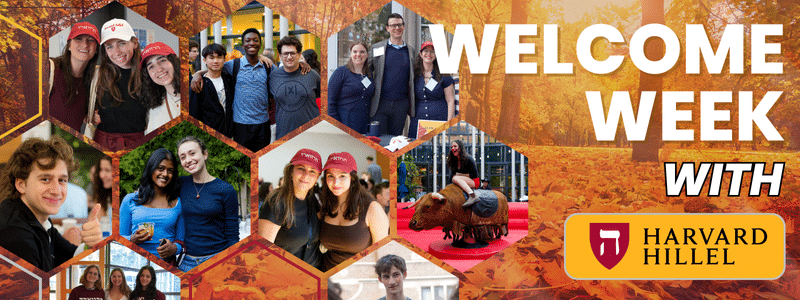
And – I couldn’t help but be moved at the juxtaposition between the vibrant chatter among the class of ‘29 in the Safra courtyard last week, and the previous gathering upon those very same bricks, an early-summer sendoff for the class of ‘25 three months earlier. Each celebrated a transition, a passing spoke in the ever-spinning wheel of time – together offering a glimpse of the timelessness that is the Jewish tradition, and the Jewish people. And more – while the individuals were different, the scenes could have unfolded, and did unfold, without much difference for the classes of ‘05 and ‘09, or even ‘95 and ‘99. We sustain Jewish life not only by mastering the crisis of the moment, but also by holding the forces of history at bay, allowing something eternal to emerge in a stillness beyond time.
I hope this short video conveys how the life of the Jewish community at Harvard, which begins on campus and extends to each and every one of us, is strong and vibrant precisely because we neither ignore nor are engulfed by our divisive and high-stakes context.
When we do this, we ensure that Jewish life at Harvard will both endure and flourish: that there will be a substantial Jewish community where students will find kind friends and generous mentors, and a Jewish life rich enough to sustain them through the challenges their generation will face.
As we begin this new year together, I want to thank you all for constituting, through your attention and your care, this great and vital community. It is no simple thing to be Jewish – and in that complexity is its genius and its beauty. All of us together make up the community that has just welcomed the class of ‘29 with a warm embrace – I can’t wait for you to meet them, and to see what we’ll create, together.
Shabbat shalom,

Rabbi Jason Rubenstein
Executive Director